Tuesday, March 29, 2011

Haunt Show Installation, Zephyr Gallery, Louisville, KY

Process is often easier for me to talk about than concept. However, the process and the ideas for this show are similar in that they are both multi-layered. The simplest expression of my concept for this installation is that it is a tribute to my love of the landscape in and around Kentucky -my love of being part of the natural environment. State boundaries are a man-made construct, so it is problematic to label this as solely a Kentucky landscape. The more complex conceptualization behind this installation is that I am attempting to recreate the feelings and fantasies I experience in my natural surroundings to share with a gallery audience.
I don't believe large-scale installation pieces happen through the artist alone. In my case, I have many people to thank for helping me get this show ready. First, I need to thank a few donors who stepped in to help make this happen. One year ago, in March, The Kentucky Museum of Art and Craft awarded me with a residency that gave me a public space, funding for supplies, and a stipend for my time. This allowed me to explore ideas about an installation piece that I had been thinking about. Being given a new space in which to play with these pieces, and the funding to do so, was invaluable. In addition, as I was running short on my budget to finish this installation, The Louisville Visual Art Association awarded me with a Linda Schaaf Micro-Loan, and The Kentucky Foundation for Women matched the loan.
I also want to thank the people who have continuously supported my work through their hard work and volunteerism, Scott Henderson (ADI Studio), has done the photography and installation for most of my shows through out the past seven years. Terri Wunderlich, for child care and installation, Jocelyn Moore, and Greg Acker (boats).
Artist Statement

My desire to depict my natural surroundings in a gallery setting goes back ten years ago when I did a class with Judi Chicago. In one of her lectures, Chicago talked about how we live in a male-dominated Western society that places priority on technology and building over being good stewards to our natural environment. She viewed this as an imbalance in power between men and women –men being associated with technology and building, women being associated with nature. As a Women Studies minor/Fiber Arts major, her words and ideas left a strong impression on me and my work, which have included themes in feminism, the natural landscape, and processes often associated with women.

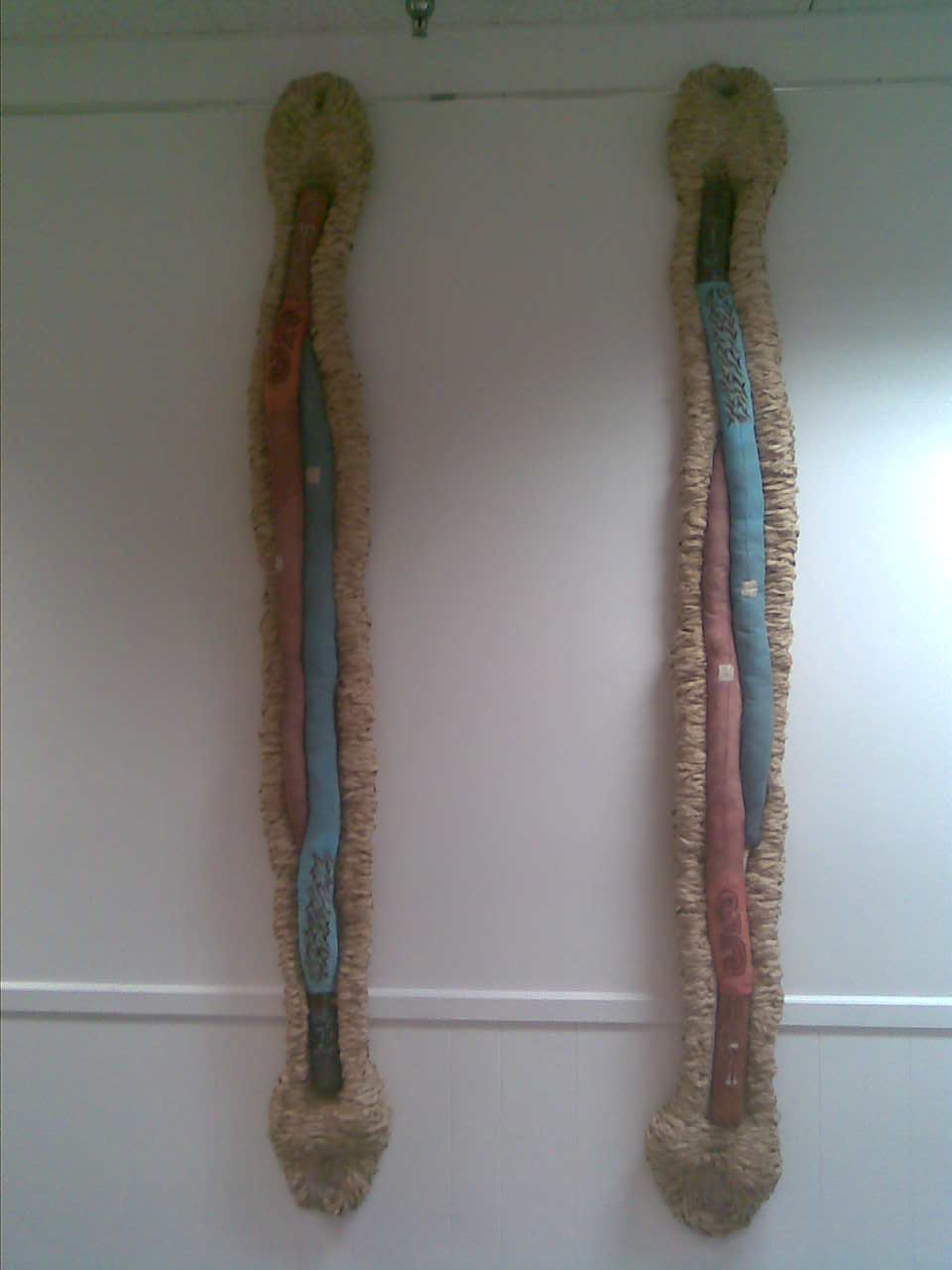
In late 2009, after taking a year and half break from working in my studio I wanted to revisit ideas from my first show at Zephyr, Costumes and Vessels that included an installation of stalactite/stalagmite vessels. At the time I was still hung up on the idea of vessels, womb/women, as a form to depict the natural world, but was no longer interested in generalized landscape images. I was nurturing a desire to create a whole environment that would convey my own fantastic impressions, overwhelming feelings of comfort and importance about the specific natural landscape surrounding Louisville. So in January of 2010 I created the Ohio River Rising on a Tree Line pieces (upstairs) and applied for a residency at The Kentucky Museum of Art and Craft. I was interested in the residency because of it’s proximity to the Ohio River and wanted a supporting environment to work out my ideas. Early in my five month stay at the museum, I attended a lecture by Judy Pfaff, which inspired me to make the full commitment to doing an installation that transformed my whole environment, not just dabbled.

During my residency, Todd Smith had visited my studio, I had wanted him to see the work because his work is closely tied to nature and specifically trees. Later, after I moved back into my home studio, Todd had asked me to view one of his pieces he had done focused on the flooding of the Ohio River. When an opportunity for us to show at Zephyr came up, I approached him about doing a conceptual collaboration on visually depicting a long-term flooding of the Ohio in the gallery space. We talked about how the downstairs would describe the results of an event causing the river to stay flooded, (what my work was evolving into) and the upstairs would describe how humans had evolved into living in trees again. From that point our beginning concepts have evolved independent of each other. Although I’ve stayed with our original concept, for my installation portion I became less concerned about just showing a flooded room and more concerned with transforming a whole environment that conveys the fantastical and sometimes close feelings I have revisiting the natural landscape in our area.

Haunt opens Friday, April 1, 2011, 6-9pm at Zephyr Gallery, 610 East Market Street. Gallery Hours are 11am-6pm, Wed-Sat. Artist Talk and Reception is scheduled for Thursday, April 14, 2011, 6-9pm. Closing Reception is scheduled for Friday, May 6, 2011, 6-9pm.


Post Card images Haunt Show, Zephyr Gallery, Louisville, KY


Wednesday, January 12, 2011

Pushing forward with work for 2011 Zephyr Show

Gosh, can't believe I haven't blogged about the installation/environmental piece going on in the studio since Oct, 2010. Just an example of how crazy it gets trying to work on large-scale-installation work, other smaller stuff, teach, raise children, etc. The images below were taken today. They are of Todd Smith working on one of his pieces for our upcoming show at Zephyr Gallery. The show opens April 1, 2011 so we are down to crunch time. Both of our work is taking up so much space we can no longer share my studio, so Todd is working outside of my studio in sub-freezing temps. Ug!


This is one of his "nest" pieces he is constructing out of cuttings from the Crape Myrtles in my front yard. I knew I had been saving these cuttings, done over a year ago, for something.
The images below are the installation going on inside my studio and are my work. Unlike the installation/environmental piece I did at the Kentucky Museum of Art and Craft, this piece involves me weaving back into the strips hanging from the wall.

All of the images in this post are a small example of the work being done for a much larger environmental installation going up at Zephyr Gallery in March. This whole process, much like other shows, can be frustrating, exciting, and disappointing at times. Like many other artists working on large-scale pieces I couldn't do it without the support of other organizations, family, and close friends. -more on that in next post. Todd and I will be doing a gallery talk in mid-April 2011 about our process for this show.


Tuesday, October 5, 2010

Moving back into home studio

In mid-August I moved back into my home studio to begin work on an installation in Zephyr Gallery for April 2011. My fellow artist friend, Todd Smith, and I have decided to do a collaborative installation on a sort of post-apocalypic flooding of the Ohio River and the resulting habitat for the remaining humans. Our plan is to use the natural flood line of the building to construct an atmosphere in the bottom of the gallery that is a flooded Ohio River with floating sculptural pieces and strata. The upstairs of the gallery would be transformed into the canopy where human size nests will be created from both natural and left over man-made debris. This is difficult for me to fully explain in writing because sometimes I think so visually that translating what I do in the English language can be difficult for me. Hopefully as I begin to document the process and post more blog pages about it, it will become more clear.
These are strips of cotton dyed muslin hanging on my clothes line to dry and later be tied to 1"x2"x8' wood strips for installation.
Because I need most of my studio for the installation, I've had to begin a new process of organization for my materials. Like other installation artists, I can not survive on creating installation art alone. I also create smaller works and teach, so I've got to have a studio that can accomodate my various needs. Very Challenging. And the picture above represents how condensed I've started to become with my supplies.
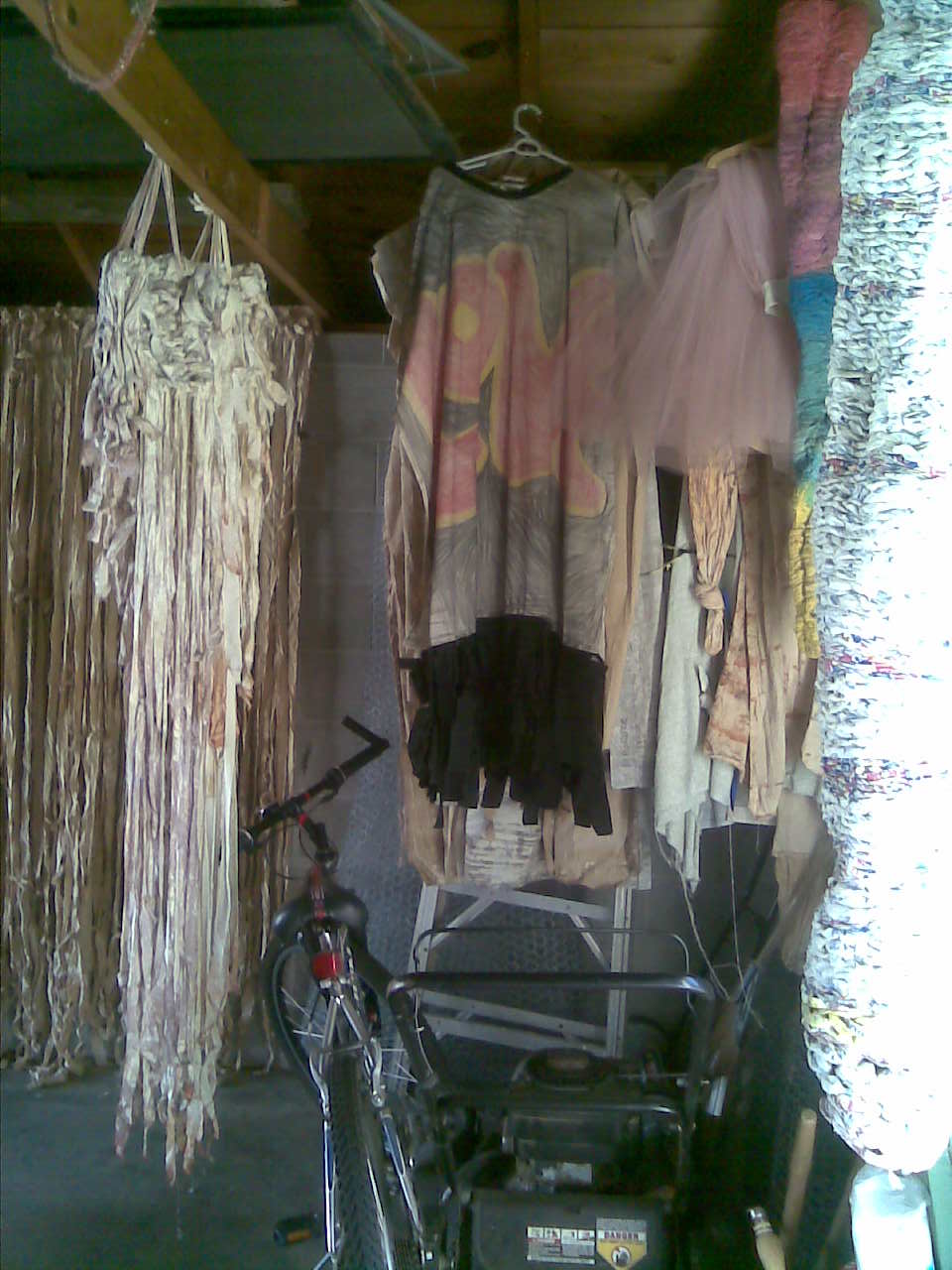
As you can probably see from this photo, my studio is inside of a garage that also has to hold sculptures and costumes from past shows as well as a bike and a lawn mower.

This is my first attempt at laying out the installation I began in my studio at the Kentucky Museum of Art and Craft. I'm sure this will change many more times over the next few posts as my process moves forward.

Friday, September 3, 2010

May Review/Interview of My Work by Margaret Phillips for KMAC

(May 2010)
KMAC Artist Spotlight: Fiber Artist Michelle Amos,
Kentucky Museum of Art and Craft's Artist-in-Residence
by Margaret Phillips

In a triptych of her most current artwork, 'Ohio River Rising on a Tree Line,' Michelle Amos' Ohio River flows in a silent rush. Each of her sculptural fiber vessels reveals warm-hued river water moving steadily over soil, roots, trunks, branches. From one vessel to the other, it is easy to imagine the left-behind history of the river: the rich dark water lines etched into tree bark, the gradual channels being carved into the submerged limestone. Amos' vessels bring to life the conversation taking place between tree and river, soil and stone. In the grace of movement, each sculpture reveals the beauty in the asymmetry of the other's biology: water and tree, each singly perfect in their interlocked states.

Louisville-native Amos, KMAC's newest Artist-in-Residence, credits her father with influencing her love of the water through a childhood spent reading Mark Twain's stories. Rounding out the Mark Twain experience, she once spent on a two-season stint on a commercial fishing boat in Alaska. One event that furthered her fascination with large bodies of water was the experience of traveling through a locks system to reach the Pacific Ocean.

'We have the locks [in Louisville], but the only time I've traveled through a locks system was in Washington, on a commercial fishing boat leaving the port of Seattle heading for the open ocean,' she says. 'It's an amazing system to go through.'

Amos' vision for her current sculptural work will eventually include two more sets of large-scale Ohio River-based triptychs, as well as smaller-scale woven pieces. Part of her inspiration will come from her KMAC studio's close proximity to the Ohio River, as well as from her journals documenting numerous hiking trips along the river's banks. Some of her smaller scale vessels include what she calls 'peepholes,' after the peephole knots in wood and shells that she's discovered while hiking.

'I've moved away from Kentucky many times, and each time that I come back, I love it more, embrace it more,' Amos says. 'Several things influence my interest in the river: my love of large bodies of water, my love of Kentucky, and just how powerful and awesome the Ohio River is.'

A visual and performance artist, Amos' work is centered in her background in fiber arts. Initially interested in physics and art as an undergraduate student, Amos discovered her love of fiber art in a class taught by Lida Gordon at the University of Louisville.

'My first thought was that I would study fiber to inform my sculpture,' Amos says, 'but Lida turned me on to the work of so many interesting fiber artists. Joan Livingston was one artist whose work I immediately took to. Lida was nurturing; she challenged me to be a better student and artist. I found my home in the fiber studio, and it was sculpture that ended up informing my fiber art.'

KMAC's Artist-in-Residence program, made possible through a generous grant by the Windgate Charitable Foundation, has nurtured the talents of four other artists since its inception in January 2008. As an Artist-in-Residence, Amos enjoys museum-based studio space, a stipend for supplies and work, exhibition invitations to one or more shows at KMAC, as well as the opportunity to demonstrate her works-in-progress to the public.

'I'd like to think that my work reminds people of nature,' Amos says. 'We live in a very masculine world, and if you're in or near a city, you become so removed from the source. I feel that my work seeks to find a feminine balance in the world. Not all of my work is about the natural world; sometimes, it is about issues, feelings or relationships that are deeply personal, but I almost always use natural elements to express those ideas.'

As an artist educator who will graduate from the University of Louisville in August 2010 with a Masters in Teaching Special Education, she feels a kinship with KMAC.

'I have an enormous respect for what the Kentucky Museum of Art and Craft does and represents in its gallery spaces, retail space, and especially its support for education and local artists,' Amos says. 'The work represented at KMAC is high quality, with a good mix of national, regional and local artists. Often, the work that I've seen at KMAC is interesting, quality work that I've seen nowhere else. I'm extremely proud to be a part of KMAC as an artist who teaches workshops and now as the Artist-in-Residence. It truly is an honor to be here.'

Amos will continue to work on her sculptural fiber vessels in her third-floor KMAC studio space until August 15, 2010. The public is invited to stop by to observe her works-in-progress and to learn more about fiber arts.

Recent Interview by Elizabeth Kramer for The Courier-Jounal

The First Time Sculptor Michelle Amos' first dip in the Ohio
August 8, 2010

I do remember swimming in the Ohio when I was a kid. I went with my mother and one of her friends on a boat and we jumped in. It had a different smell to it than a swimming pool — and definitely I remember that when it was hot. It also had muddy banks and debris, because you have a lot of trees and such that make debris, but you also have garbage that kind of floats and gets caught up on the banks. But when you're a kid you don't care because you're having fun.

Trips — and moving — to the West Coast emphasized how different it is. I'd come back here and the Ohio just seemed like another world.
My grandmother grew up in the Parkland neighborhood when there was the 1937 flood. She would talk about it all the time and that probably had a lot to do with my interest in the Ohio. And I remember the year I was pregnant with my son, 1997, and the Ohio flooded.
Michelle Amos recently completed a residency with the Kentucky Museum of Art and Craft, 715 W. Main St., where she completed a fiber-based sculptural installation called “Ohio River Rising on a Tree Line.” The installation will be on display in her studio at KMAC through Friday. Amos also will exhibit the work next spring at Zephyr Gallery, 610 E. Market St

VSA Art Installation in Bowling Green

Yesterday afternoon I drove to Bowling Green, KY with artist Brenda Wirth and her husband, musician, Greg Acker to install a group show at the VSA of Kentucky's Arts Access Gallery. VSA is a statewide, nonprofit organization dedicated to promoting arts, education and creative expression for all, with an emphasis on persons with disabilities. VSA Executive Director, Delaire Rowe, worked with Wirth to put the show together to showcase some of VSA's teaching artists on their roster. I've collaborated with Wirth and Acker individually and as a couple over the years on several projects. This project was different in that it is the first time the three of us were doing a formal show of just our work. Even though our choosen mediums are completely different, walking through the show you get a glimpse of our commonalities and a key into probably why we are good collaborators, friends, and inspiration for one another's work.

The above picture is Wirth standing behind one of her vinyl pieces with one of Acker's homemade instruments, Imbira Harp, behind her. Wirth's vinyl pieces were done in pairs for a show we did together on symmetry. One in each of the pairs is vinyl on vinyl with it's counterpart paint on vinyl.

Because so much of my other work is in progress, and I need to reference my new pieces, I brought six pieces from my older doll series (2008). The blue and red dolls are approximately 7.5 feet in height where the other two dolls are approximately 4.5 feet and 4 feet. Although it looks from these picture the dolls are hung in isolation from Wirth and Acker's work, that is not the case. All of our work is actually intermingled throughout the show.
Here Acker is tuning one of his drift wood instruments, Driftwood Koto. The chime instruments, Homemade Gamala, in the corner are all tuned to the black keys of the piano so that a pleasing sound is made no matter how you play them or how skilled you are at music. Acker is brilliant in his adaptations to instruments. He uses many techniques to make music making accessible and comfortable. In addition his calm, open, and welcoming demeanor draw even the least gifted at music into his world of exploration and playfulness.
Here you see the work of all three of us together. One of Wirth's pieces from a series of paintings she did looking up to the sky through trees. I believe this piece is called River Dweller. Next to it is a pair of my dolls titled Convulused Reunion for Michelle and Convulused Reunion for Melissa. Below is one of Acker's driftwood instruments with a gourd attached. It is hard to see from this picture but the diftwood is stung in two places, along the entire length of the piece and then a small section toward the right hand top.
The reception for this show is in conjunction with The Bowling Green Gallery Hop, Friday, October 15, 2010 from 5-8pm at VSA's Arts Access Gallery, 515 East 10th Street Bowling Green, KY 42101. Gallery hrs are Monday - Friday8:30AM - 4:30PM and the phone number for the gallery is 270-781-0872.